GolfStinks

A Golf Blog for the Rest of Us!

  • Home
  • About
  • Most Popular
  • Categories
    • Stinky Golfer Paradise
    • Golf Life
    • The Pro Tours
    • Reviews
    • The Economics of Golf
    • Golf Growth & Diversity
    • Health & Environment
    • Golf Destinations
  • Golf Terms
  • Newsletter

Purple Mountains Majesty: Golf New Mexico

January 13, 2010 | By Greg D'Andrea | Leave a Comment

Please forgive me if I insult your intelligence, but in 1912 New Mexico became the 47th state admitted to the Union. If I took a mulligan every time someone asked me back East: “Now, what’s the difference between Mexico and New Mexico,” I’d have a scratch handicap.

New Mexico: The Land of Enchantment. It’s home to the oldest state capitol (Santa Fe); the roadrunner (beep, beep); and green chile (wow, that’s hot)! It’s a state that defines the American landscape; a place that inspires the artist in all of us; and a terrain that flowers two of the top public tracks in the country: Paa-ko Ridge Golf Club and Black Mesa Golf Club.

Paa-ko Ridge is ranked 28th on Golf Magazine’s Top 100 Courses You Can Play, and at $90 during the week, this course is a steal (I’d pay $90 for the scenery alone)! Nestled in a new community between Albuquerque and Santa Fe, you’re absorbed in rugged mountains and high-desert terrain. It truly is a sight to behold. But beyond the aesthetics, Paa-ko is a nice challenge too. The course offers five tee boxes, and plays 7,562 yards from the tips with a slope of 138 (don’t worry about length – at an altitude of 7,000 feet, you’ll be setting your personal driving-distance record).

Meanwhile, Black Mesa (ranked #36), is the newer of the two young courses (2003 vs. Paa-ko’s 2000), and is a mere $82 to play during the week. Just a short drive north of Santa Fe, Black Mesa sits outside the town of Española. The course’s fairways are encompassed by arroyos, while many of the holes are surrounded by canyons and jagged mountains – all part of a landscape native Pueblo Indians have enjoyed for centuries. Black Mesa is not as long as Paa-Ko, but it plays a little tougher, with a slope of 141 from the back tees (7,307 yards).

While Arizona is a typical golf destination for many northerners, New Mexico should not be overlooked – the golf, food, and prices are completely worth it. Stay a week and go whitewater rafting on the Rio Grande, and play other notable courses in the area like Twin Warriors and the Towa Golf Resort. Hit the casinos at night and don’t forget to eat. New Mexican cuisine is like none-other. A must-stop in Santa Fe is Tomasita’s (have the stuffed Sopaipillas) and when near Albuquerque, try El Pinto (the chile rellenos are pretty darn good). But beware – whichever chile you choose for your meal (red or green), it will be HOT.

New Mexico golf in general, but Paa-ko Ridge and Black Mesa especially, have what many golf course designers long for: an awesome location. These courses will capture your imagination on every hole and around every corner awaits a new challenge with another spectacular view. Golfing in New Mexico is an experience that needs to be realized by every stinky golfer in this land.

For more New Mexico trip info, please click HERE.

Filed Under: Golf Destinations Tagged With: black mesa, el pinto, Golf Magazine, new mexico, paa-ko ridge, tomasita, top 100 courses, twin warriors

The Economics of Golf

January 6, 2010 | By Greg D'Andrea | 4 Comments


5ThingsWrongWithGolf
Now that the public has been formally introduced to mortgage-backed securities and collateralized debt obligations, I thought our readers would like to know golf is doing its part to help the economy.

It may surprise you that PGA players (and the pro tours in general) contribute just a small amount to golf’s total economic impact. Instead, it’s average golfers like the majority of us that help drive golf-related revenue and subsequently stoke the economy.

According to the most recent study by Golf2020 (conducted in 2007 for the year 2005), golf’s total economic impact is nearly $76 billion annually. Of that figure, all the pro tours combined (PGA, LPGA, Champions, etc.) contributed just $954 million (or about 1% of the total).

Compare that to what we spend to play golf each year (around $27 billion), or on golf-related travel ($18 billion), or on golf equipment ($3.7 billion), or golf apparel ($1.5 billion) – Heck, we even collectively spend a billion dollars at the driving range annually! Actually, we must really want to improve – not only do we spend at the range, but we also plunk down nearly as much ($925 million) on golf-related magazines and books.

Beyond its sport and recreational value, golf is at the heart of a major industry cluster that generates jobs, commerce, economic development, and tax revenues for communities throughout the country. – Golf2020

Golf2020’s methodology extrapolates additional economic impact from the golf industry to include the golf-related jobs and wage incomes surrounding all the aforementioned golf products and services. Furthermore, golf real estate was included in the mix (nearly 64,000 golf course homes were constructed in 2005). Taken as a whole, Golf2020 estimates that golf contributes more than $195 billion annually to the US economy (see chart below). Now that’s allot of green to spend on the greens!


While it would be interesting to see more recent data given the spending decline of the last two years, the 2005 study still suggests golf’s economic importance in the US. Golf2020 notes the golf industry seems to be “staying ahead” of inflation, and golf outperforms industries including other spectator sports and motion pictures.

The full magnitude of every round you play or every golf-related purchase you make rarely comes into perspective, but its nice to know we’re contributing to the health of the overall economy – especially these days. So get out there and keep playing!

Golf2020’s full report can be found HERE.

Filed Under: The Economics of Golf Tagged With: economics, economy, golf, golf 20/20, golf2020, PGA, real estate

What the Crap is a Slope Rating?

December 23, 2009 | By Greg D'Andrea | 4 Comments

Ko'olau Golf Club
Ko’olau Golf Club in Hawaii is widely considered one of the toughest golf courses in the world

We here at GolfStinks can appreciate playing a round of golf without understanding all the idiosyncrasies of the game that serious players, well, take seriously. But sometimes things that seem inconsequential to you can actually help put this crazy game into better perspective. Thus, I’ve decided to shed some insight on a golf measure that is rarely understood (or paid much attention to) by the weekend hack: The Slope Rating.

You see it on the score card and think “what’s this mean?” and “why do I care?” Well, chances are unless you keep a handicap, you won’t know what a slope rating is, nor will you care…but you should and here’s why: It’s true the slope rating factors into calculating a handicap, but if you don’t keep a handicap, it can still be useful. In most basic terms, a slope rating is there to help average hacks like you and me understand how tough a course is.

To give golfers an idea of its difficulty level, the USGA will assign a number (or rating) to each tee box on a course. The higher a rating, the tougher the challenge. The maximum slope rating handed out by the USGA is 155 (average is around 127 from the back tees). Currently, the only course to have a rating of 155 is the Ocean Course at Kiawah Island in South Carolina. It should be noted that Ko’olau Golf Club in Hawaii (pictured) is widely considered one of the toughest courses in the world and previously carried a slope rating of 162 from its back tees – a rating not possible under USGA rules. Ko-olau’s current rating from its tips is 152.

Anyway, there are a couple reasons a course has a high slope rating:

First reason: The course is longer. It’s been decided that 6,500 -7,000 yards is an average length for a course. Courses shorter than this will usually have a below average slope rating (e.g. less than 127 from the back tees), while courses longer than this will have a higher slope rating than the average.

Second reason: The course has a lot of defenses. Sand traps, water hazards, narrow fairways, high rough, etc. Some or all are usually present to make sure there is a sufficient challenge.

So, the next time you play, take a look at the scorecard for the course’s total yardage and slope rating from each tee box. If it’s a short course, but has a high slope rating, chances are there are good amount of defenses. If it’s long with a low rating, chances are the course is pretty wide open. If it’s a short course with a low rating, the course probably features a relatively easy layout (or features a windmill and clown’s mouth). Finally, if it’s long with a high slope, you’re on a tough course (or more likely at a PGA Tour event and are viewing the festivities from behind the yellow rope).

That being said, knowing the slope rating will help you decide which tee boxes to play from and give you an idea of what to expect as far as difficulty. Let’s face it, most stinky golfers will end up playing from the forward (white) tees, but if the course has a really low slope from there (and you feel like giving yourself more of a challenge), you might opt to play farther back.

As I’m sure many of our readers can confirm, there’s nothing worse than a bad golfer playing from the wrong tees. So check out the slope rating and make the appropriate choice based on your skill level.

Please note: The “course rating” is another measure rarely paid much attention to by the average weekend hack…and it should stay that way. This is a measure for scratch golfers and those keeping a handicap.

Filed Under: Golf Life Tagged With: course rating, rules of golf, slope rating, USGA

If Golf Carts Could Talk…or Scream

December 16, 2009 | By Greg D'Andrea | 1 Comment

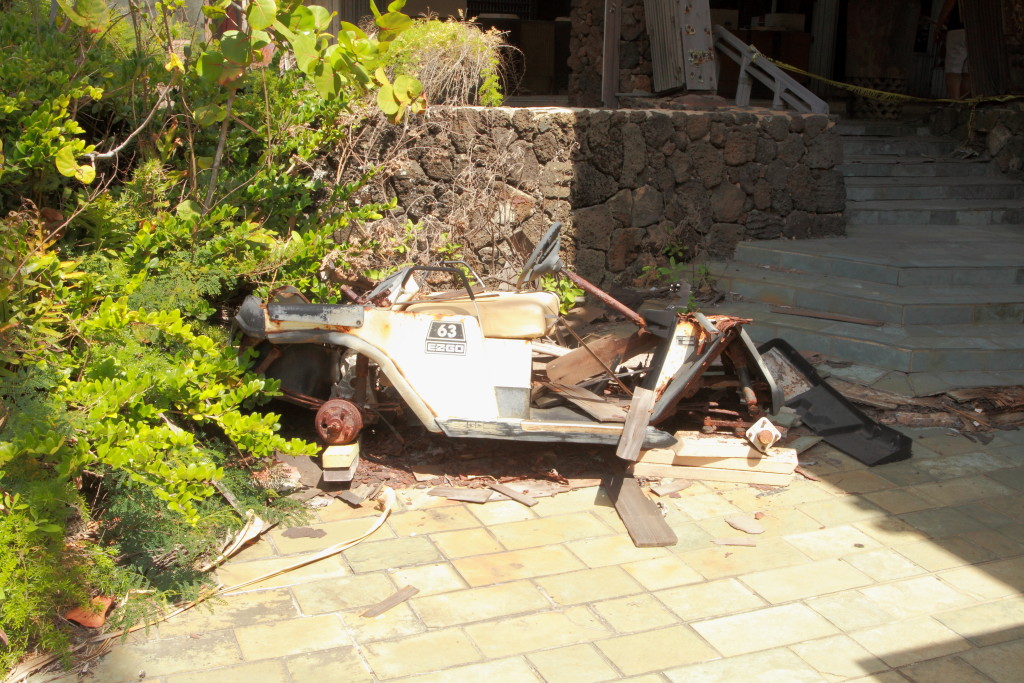
Demolished Golf Cart (photo by Jeff / CC BY 2.0)

Oh the abuse golf carts take. It’s as if we could care less that these things aren’t our property. We put our muddy golf shoes all over the cup holders and drive them like Kawasaki ATV’s – through the woods and down steep hills like we’re in some off-road relay race.

In fact, the golfers that recently provoked a Canadian judge to order the Happy Gilmore swing illegal also nearly drove their cart into a pond during the same round. Usually (as in the Happy Gilmore case) the abuse ensues after a bit of drinking and driving on the course. For example, my friend Dave tells a great story about a twosome he was paired-up with during a golf tournament one time:

Four of us were supposed to play [but] two of the guys canceled so my friend asked if I minded if he invited some “drinking” friends to come along. It was hard for them to secure the full-size cooler in the little basket on the cart – but they managed and after about 8 holes they were both completely lit. There’s a hole on the back where the rear of the green slopes down. In an effort to save time, they tried to circle around the back of the green with the cart floored (Yes, all 5 horsepower). The angle was too much and the cart rolled onto the roof amidst screams and a shower of beer cans from the cooler – some of which exploded on contact. It took the 4 of us to get the cart back on its wheels. After the round, we dropped the cart off and got the hell out of there. As I was leaving the parking lot, I could see the grass stains on the roof of the cart!

A quick YouTube search will provide similar antics caught on tape. But drinking isn’t always the cause. Some years ago, my friend Tom and I were driving our carts up to the tee on the 15th hole of a public course completely sober. This particular hole’s tee box is elevated slightly and, I’m not sure why, but Tom decided to park the cart just below the tee box. Also, he backed in, so the front of the cart was facing the fairway (I guess to make a quick getaway).

Needless to say, Tom hauled-off and ripped a line drive that had uncanny sinking action. The ball headed right for the middle of the cart like a dart for the bulls eye, perfectly split our two golf bags, and then, as if in slow motion, careened through the Plexiglas windshield to leave a softball-sized hole in its wake. Did he do it on purpose? No. But did he want to pay for the windshield? Hell no. We finished our round, parked the cart back at the clubhouse among all the others, and high-tailed it out of there.

Whether you’re inebriated or not, it appears the sight of a golf cart conjures up the urge to conduct shenanigans – especially for men – drunk men more so. As if the golf cart was our own personal go-kart in which all responsibility goes out the window when we get behind the wheel. As Stinky Golfer Chris referenced in a previous post, a 2008 study by the University of Alabama at Birmingham found that around 1,000 Americans a month are injured in golf cart accidents. One thousand!

A person associated with the study reported: “A lot of people perceive golf carts as little more than toys, but our findings suggest they can be quite dangerous.” This statement hits my earlier point – whether you plan on acting like an ass in a golf cart or not, it seems people look at golf carts as benign toys – they’re there to have fun.

But beware. Courses can and will prosecute you if they have your name and can tie you to the cart (for example, if they make you sign the typical rental agreement before giving you the key). The likelihood of prosecution depends on the amount of damage done, but it has happened.

In the meantime, feel free to share your own stories of golf cart high-jinks by commenting below (commenting as “anonymous” is understandable).

Filed Under: Stinky Golfer Paradise Tagged With: golf buggy, golf cart, golfstinks, happy gilmore, kawasaki

Golf Ball Hell

December 9, 2009 | By Greg D'Andrea | 3 Comments

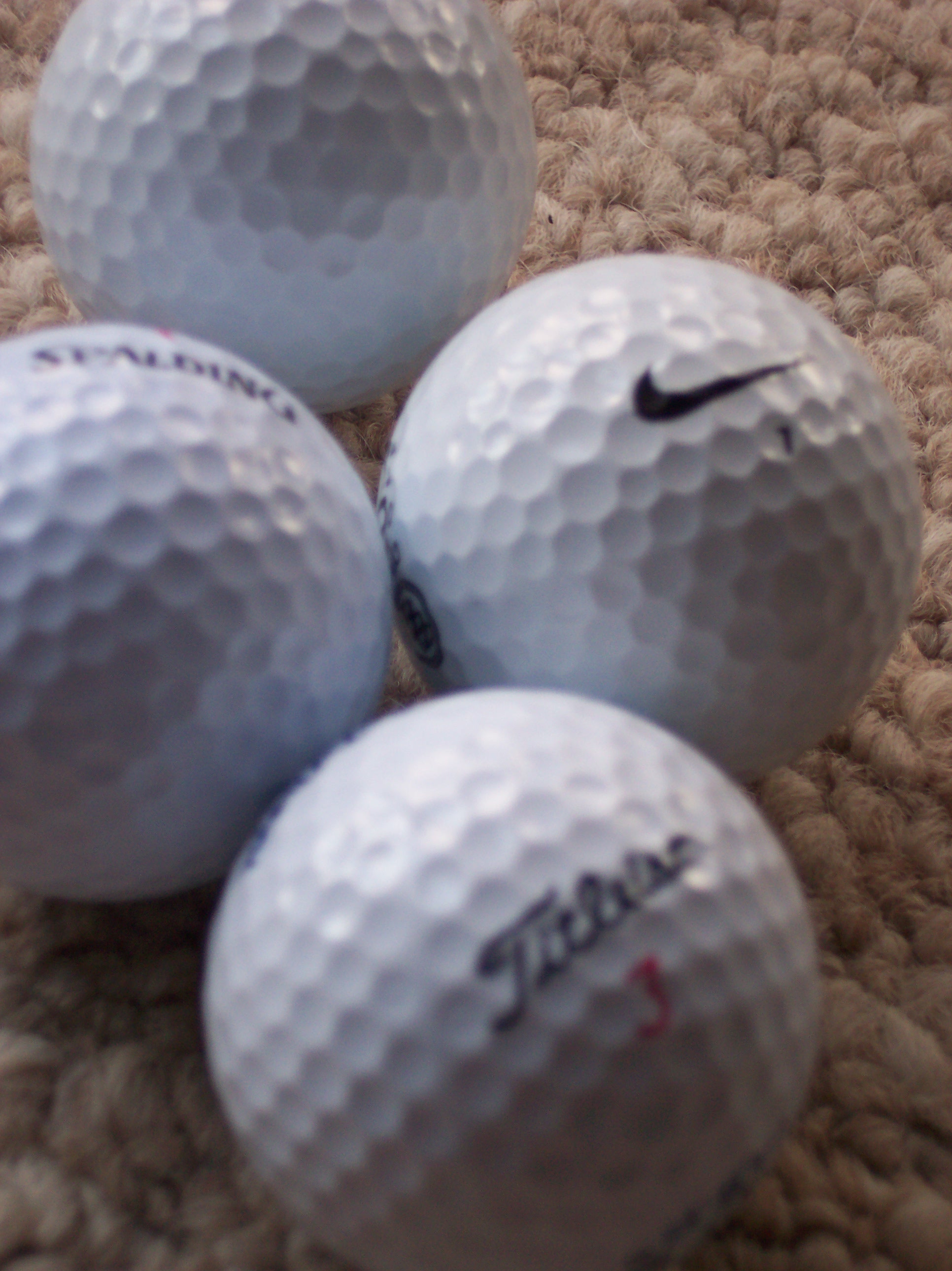
100_0231You can have a nervous breakdown trying to pick out golf balls. I hope I’m not alone in this assessment, but I can literally stand in front of a wall of golf ball boxes for like an hour, trying to figure out which ones I should pick.

Newbies to golf typically will purchase the cheapest options – Top Flite or the like, where $10 can buy you 20 balls. I envy those new golf hacks – the choice is easy for them. $10 for 20? That’s a no-brainer. They figure the balls are destined for the drink or lumber yard anyway, so why spend more?

However, I’ve been playing golf for 20 years. I know why I won’t spend $10 for 20 Top Flite’s. I’d like to have my ball last more than a hole without scuffs on it, thank you very much. And I’m not a terrible golfer either – I understand what “feel” means when it says “better distance and feel” on the side of the box – I want it to land softly and “hold” the green.

But I also know I’m no “player.” I don’t “work the ball” too often, I don’t really “cut it,” or intentionally draw or fade it with much success…So I don’t need to spend $45 on a dozen three-piece balls like the Titleist Pro-V1. Yes, I’ve narrowed it down to the $20 to $30 range for a dozen balls. That’s where I’m most comfortable – where I get a decent ball for a decent price. But there are so many options in that price range – which inevitably leaves me standing for an hour in the golf-ball section of my local sporting goods store.

To make matters worse, I just realized there are now more options for me to choose from…Options that I previously ignored when I was shopping for balls: Recycled golf balls. Most golfers intentionally overlook recycled (or refurbished) golf balls for various reasons, but my main reason was that I always heard once balls were submerged in water or out in the elements for a while, quality and distance would be hindered. But a new study done by GolfBallTest.org says otherwise. In their tests, there was virtually no difference between new and recycled balls of the same brand. This is intriguing.

After reading the white paper on the study, I picked up a dozen recycled Nike One balls at Target for $9.99 and played a few rounds with them. I have to say, I was impressed with them – impressed to the point where I will probably buy another box next season. If this study gets some publicity, it may change the golf ball industry!

But another new discovery has me ever more intrigued. There are companies out there that will actually custom fit you with a golf ball…and do it all online no less. GolfBallSelector.com touts “a mix of quantitative and qualitative measures to generate precise [golf ball] recommendations.” For just $19.95, you get a one-time fitting to match you with your balls. Interesting. You’ll find a similar site at TheRightBall.com. So there’s two ways you can look at these golf-ball-fitting sites: Either they’re a rip-off and not worth considering; Or your days of wondering what golf ball to use are over.

While one day I may fork-over the 20 bones and take the Golf Ball Selector test, I think for now I’m gonna stick to my recycled Nike balls…at least until another study comes along and shoots the GolfBallTest analysis out of the water. Until then, I am glad to report less of my life will be wasted on choosing golf balls. Hmmm, this post has me thinking – I wonder what grips I should put on my clubs for next season?

Filed Under: Golf Life Tagged With: golf balls, GolfBallSelector.com, GolfBallTest.org, Nike, Pro-V1, recycled golf balls, refurbished golf balls, Titleist, top flite, used golf balls

  • « Previous Page
  • 1
  • …
  • 55
  • 56
  • 57
  • 58
  • 59
  • …
  • 61
  • Next Page »

Awards

Badges Badges Badges Best Mens Blogs Badges

Advertisements

GPI


Archives – Read all 1,000+ GolfStinks Posts!

Blogroll

  • Aussie Golfer
  • Black Girls Golf
  • Devil Ball Golf
  • Front9Back9 Golf Blog
  • Geoff Shackelford
  • Golf Blogger
  • Golf For Beginners
  • Golf Gear Geeks
  • Golf Girl's Diary
  • Golf News Net (GNN)
  • Golf Refugees
  • Golf State of Mind
  • Golfgal
  • My Daily Slice of Golf
  • Pillars of Golf
  • Ruthless Golf
  • The Breakfast Ball
  • The Grateful Golfer
  • UniqueGolfGears.com

Questions / Advertise

info@golfstinks.com

Disclaimers

See here

Privacy Policy

See here

Copyright © 2009-2025 GolfStinks.com - All rights reserved.